A Defiant Community Returns a Flag to Sacred Ground
By Audrey Hill

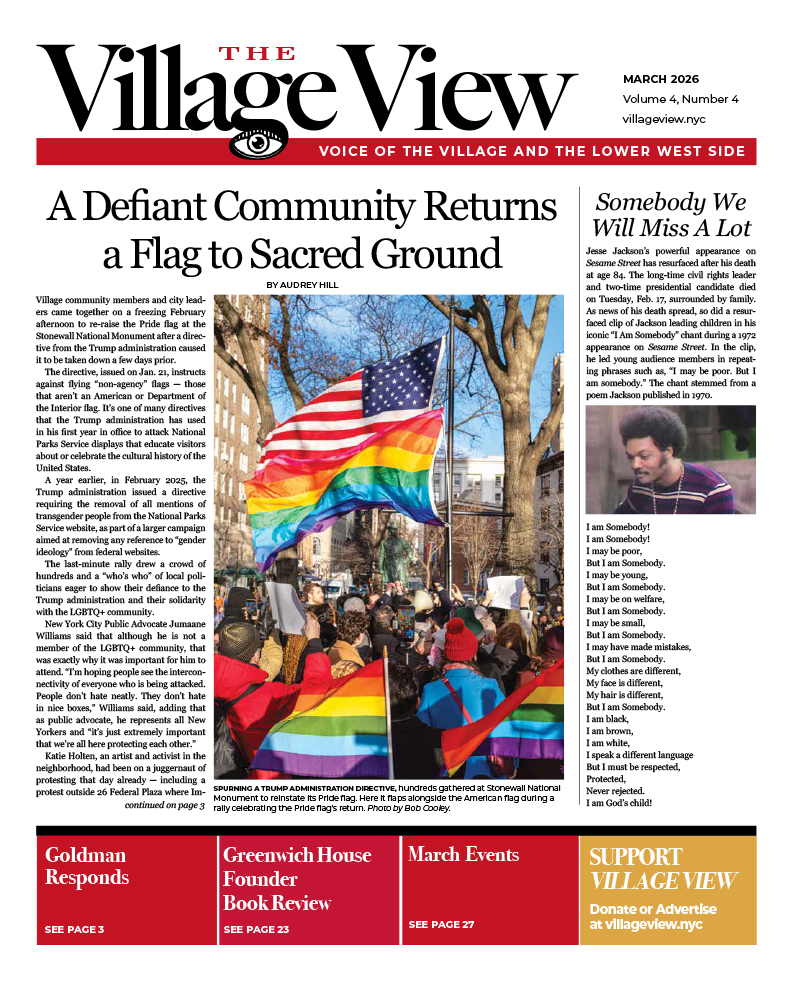
Spurning a Trump administration directive, hundreds gathered at Stonewall National Monument to reinstate its Pride flag. Here it flaps alongside the American flag during a rally celebrating the Pride flag’s return. Photo by Bob Cooley.
Village community members and city leaders came together on a freezing February afternoon to re-raise the Pride flag at the Stonewall National Monument after a directive from the Trump administration caused it to be taken down a few days prior.
The directive, issued on Jan. 21, instructs against flying “non-agency” flags ─ those that aren’t an American or Department of the Interior flag. It’s one of many directives that the Trump administration has used in his first year in office to attack National Parks Service displays that educate visitors about or celebrate the cultural history of the United States.
A year earlier, in February 2025, the Trump administration issued a directive requiring the removal of all mentions of transgender people from the National Parks Service website, as part of a larger campaign aimed at removing any reference to “gender ideology” from federal websites.
The last-minute rally drew a crowd of hundreds and a “who’s who” of local politicians eager to show their defiance to the Trump administration and their solidarity with the LGBTQ+ community.
New York City Public Advocate Jumaane Williams said that although he is not a member of the LGBTQ+ community, that was exactly why it was important for him to attend. “I’m hoping people see the interconnectivity of everyone who is being attacked. People don’t hate neatly. They don’t hate in nice boxes,” Williams said, adding that as public advocate, he represents all New Yorkers and “it’s just extremely important that we’re all here protecting each other.”
Katie Holten, an artist and activist in the neighborhood, had been on a juggernaut of protesting that day already ─ including a protest outside 26 Federal Plaza where Immigrations and Customs Enforcement (ICE) operates a field office. “That’s what life is now,” Holten said of her active political life. Protest is important when “everything we hold to be real is being mangled.”

ON CHRISTOPHER STREET, where a neighborhood uprising became a national movement, the message from supporters was that the history recognized here will not be quietly reduced. Photo by Bob Cooley.
Holten and I watched as activists navigated the complex task of hoisting the Pride flag while protesters chanted input about whether the American flag should remain flying beside it. Most, it seemed, wanted it taken down. Ultimately, though, the American flag was left flying alongside the Pride flag.
J, an activist involved with the New York City Dyke March who uses he/they pronouns, said they were left with mixed feelings about the American flag being left aloft. “It’s a little difficult to be proud of our flag sometimes,” J said. “With everything going on in the country, especially as a Black American, as a transgender American, it’s a little difficult. But I understand other people might see it as a call to unity to say that we are Americans too, and that America is also gay.”
J pointed out that the American flag is already flown in another part of the park and wasn’t raised on that particular pole until after the Pride flag was taken down. Still, they said they are at least glad to see the Pride flag flying again. “If these symbols didn’t matter, then they wouldn’t try to attack them in the first place,” J said. “I think it’s important to stand our ground and not let the little things go, before it slides into something bigger.”
Kelley Robinson, the president of the advocacy organization Human Rights Campaign (HRC) echoed the idea that symbolic victories like reinstating the flag are important. “Look, when they come for our flag, it’s not just about a flag,” Robinson said. “They are trying to erase our history, they are continuing an assault on our rights all across this country.”
The 1969 Stonewall Riots, during which queer and transgender patrons of the Stonewall Inn ─ then an underground gay bar ─ protested against a raid by local cops, are largely considered to be the birthplace of the modern LGBTQ+ movement.
Commemoration of the site, however, has been a long time coming. The Greenwich Village Society for Historical Preservation and neighborhood residents were instrumental in getting landmark status for the bar and the park in front ─ first as a national historic landmark in 2000, then as a city landmark in 2015, and finally as a national monument in 2016, during the last months of the Obama administration.
It became the first national monument in the United States dedicated to the LGBTQ+ rights movement. The designation transferred control of the area to the National Parks Service and the federal government, which Manhattan Borough President Brad Hoylman-Sigal explains was, at the time, an attempt to protect the area.
“We ceded the land to the federal government, and that was intentional because we thought that the feds were the best caretaker, but we all know now that you can’t trust Washington,” Hoylman-Sigal said. “And that’s a sad ending to what was an attempt by the Obama administration to make certain that Pride and Stonewall were preserved. But with Trump in the White House, all bets are off.”
Raising the flag has been a complicated process in itself, according to Steven Menendez, who helped get the Pride flag installed in the park and is affectionately known by community members as its unofficial caretaker.
A Pride flag was first raised in the park in October 2017, and was supposed to be the first raised at a national monument. However, a few days before its official installation, Menendez said the Trump administration announced that the flag was on a city-owned flagpole and not technically part of the Stonewall National Monument. Menendez then navigated the complex process of getting a flag permanently installed at the monument for years, at one point having to renew a permit for it monthly. Finally it was installed in 2022 thanks to the Biden administration.
Hoylman-Sigal expects the Trump administration to try to take the flag down again, but if that happens, “We’ll just raise it again. That is kind of the story of civil rights,” he said. “You keep marching forward, you have setbacks, you move forward.”