New History of 1920s NYC Offers Rollercoaster Ride Through Era with Eerie Echoes to Today
By Phyllis Eckhaus

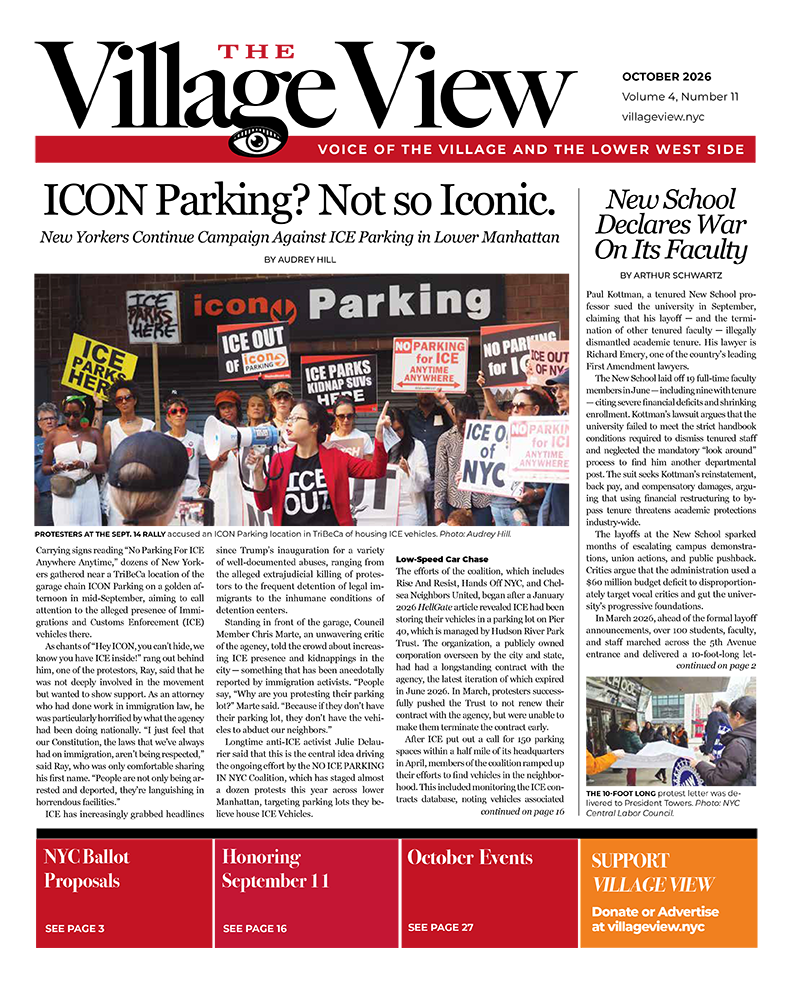
HIDDEN HISTORIES OF JAZZ AGE NEW YORK book cover art. Image courtesy of Jonathan Ezra Goldman.
I’ve been waiting for this book.
Ever since Donald Trump retook office and began weaponizing the federal government to wage war on immigrants, his perceived enemies, and everyone demonized by his loony narrow narrative of white male hetero supremacy, I’ve been eagerly awaiting an account of the creepy parallels between early 20th century America and today.
Jonathan Ezra Goldman’s Hidden Histories of Jazz Age New York: From the Suppressed to the Strange exuberantly does the job. His rollercoaster ride through New York City cultural history, focusing especially on the years 1920 through 1925, highlights how “then” often looks like a funhouse mirror reflection of “now.”
Deporting dissenters, persecuting minorities
Take the notorious Palmer raids, the massive dragnet to arrest and deport foreign-born radicals, first launched in 1919 by then-Attorney General A. Mitchell Palmer and his newly-promoted protege J. Edgar Hoover. By December 1919, they’d netted famed Village anarchist Emma Goldman and her lover Alexander Berkman — and shipped them and 247 others off to the then-Soviet Union, on a ship the press christened “the Soviet Ark.”
And that was just the beginning. On January 2, 1920, “the Palmer raids resumed with the single greatest day of political attacks in U.S. history (so far.)” Night raids took place across 35 cities and, in that single sweep, about 700 New Yorkers and 4,000 people across the country were arrested. Of the New Yorkers, 600 had no proof of citizenship and were detained for deportation on Ellis Island in conditions so squalid at least six would fall sick and die before their deportation hearings.
It was a time of targeted oppression. The Palmer raids spurred the founding of the American Civil Liberties Union, which held its first official meeting in January 1920. That same January, five Socialist Party members from New York City ─ duly elected to the state assembly ─ were voted out by fellow assembly members before they could be seated. A few months later, the head of the Society for the Suppression of Vice persuaded the police to launch aggressive raids on boarding houses popular with gay men. In Manhattan in 1920 more than 750 men were convicted of “homosexual solicitation” ─ an astronomical, eight-fold jump from four years earlier.
New York City’s Palmer raids were aided and abetted by the New York State Legislature’s Lusk Committee, which in 1919 collaborated with U.S. Army Military Intelligence to publish color-coded maps of “racial colonies” engaged in “seditious activities” in Brooklyn, Manhattan, and parts of the Bronx. “Russian, Polish, and Other Jews” were coded red for Communist. A total of ten ethnic groupings each got their own color, and were presented as geographically distinct. Goldman spritely observes that “the idea of mapping New York City by its threatening cosmopolitanism” had such mass appeal that the government maps were commercially reproduced and sold to the public.
A love letter to NYC
Linking the tumultuous past to the turbulent present is just one virtue of Hidden Histories, which is a fun read, opinionated but not preachy, and packed with startling facts. Using the Lusk maps as a jumping off point, Goldman segues into an exploration of the city’s historic diversity — and it’s clear what he’s really penning is a love letter to New York, embracing its variety, energy, oddness, and intermittent tolerance.
Over the course of 23 engaging and wide-ranging chapters, he makes the unseen visible, using yesterday’s newspapers and today’s scholarship to sketch out less well known New York contingents — including queer New Yorkers, anti-Zionist Jews, Arab literati, and Black librarians. His affection for quirky factoids extends to the city’s nearly forgotten islands and denizens. Who knew (not me!) that the East River’s North Brother Island was for 23 years the quarantine home of Mary Mallon (“Typhoid Mary”) who died there in 1938?
Along the way, Goldman makes extended forays to explore bizarrely educational episodes, like Black nationalist Marcus Garvey’s opportunistic alliance with the Ku Klux Klan and sports great Babe Ruth’s alleged Black blood and impact on baseball and celebrity.
The book’s superpower is the velocity of its prose. This is a paperback you can take to the beach and entertain or annoy your companions with your discoveries. My only quibbles reflect the current dismal state of publishing. First, I wish Hidden Histories were better edited. I’d be speeding along the narrative highway and every 30 pages or so, I’d screech to a halt over an ill-chosen word or suspect fact (for example, contrary to Goldman, the Cable Act of 1922 did not trigger loss of citizenship for American women who married foreigners — instead the Act partially corrected that outrage, which dated to a 1907 federal statute and the 1915 Supreme Court decision that upheld it). Second, the numerous black-and-white illustrations are grievously muddy in reproduction. One has to find them online to recover their impact and aesthetic appeal, and to appreciate them as well-chosen.
Fortunately, Goldman has a website, https://www.ny1920.com, that offers a compilation of errata and is replete with great public domain images. It’s a valuable addendum to his book, a volume that fans of New York City history will relish and cherish.