ICON Parking? Not so Iconic.
New Yorkers Continue Campaign Against ICE Parking in Lower Manhattan
By Audrey Hill

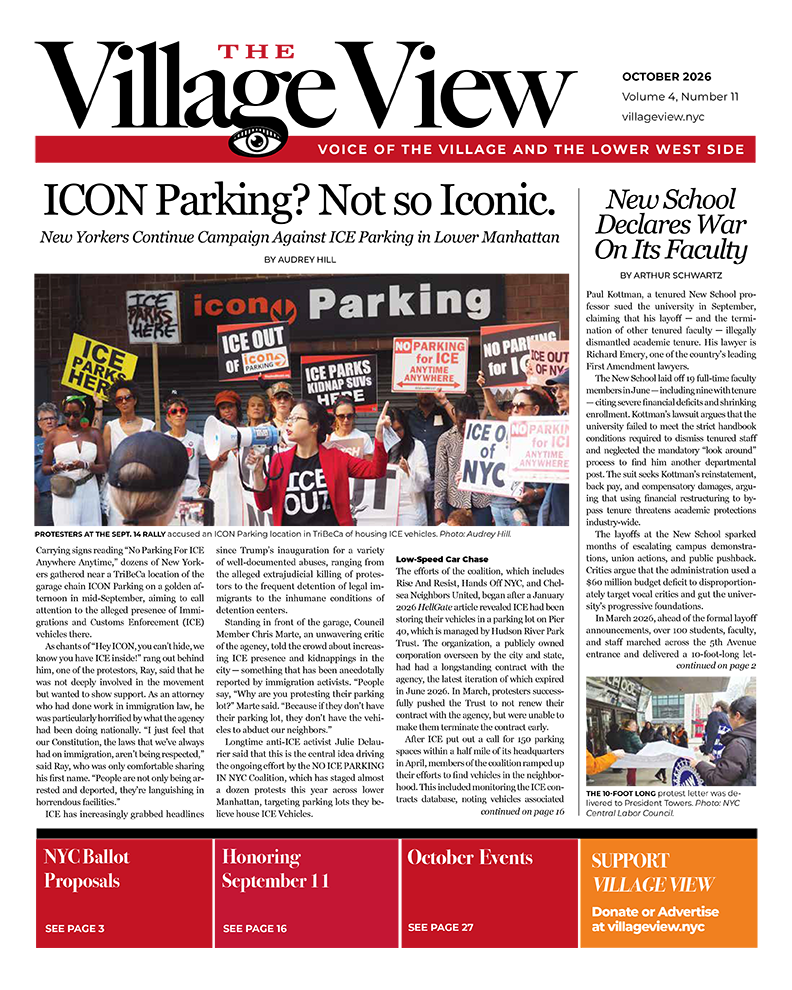
Protesters at the Sept. 14 rally accused an ICON Parking location in TriBeCa of housing ICE vehicles. Photo: Audrey Hill.
Carrying signs reading “No Parking For ICE Anywhere Anytime,” dozens of New Yorkers gathered near a TriBeCa location of the garage chain ICON Parking on a golden afternoon in mid-September, aiming to call attention to the alleged presence of Immigrations and Customs Enforcement (ICE) vehicles there.
As chants of “Hey ICON, you can’t hide, we know you have ICE inside!” rang out behind him, one of the protestors, Ray, said that he was not deeply involved in the movement but wanted to show support. As an attorney who had done work in immigration law, he was particularly horrified by what the agency had been doing nationally. “I just feel that our Constitution, the laws that we’ve always had on immigration, aren’t being respected,” said Ray, who was only comfortable sharing his first name. “People are not only being arrested and deported, they’re languishing in horrendous facilities.”
ICE has increasingly grabbed headlines since Trump’s inauguration for a variety of well-documented abuses, ranging from the alleged extrajudicial killing of protestors to the frequent detention of legal immigrants to the inhumane conditions of detention centers.
Standing in front of the garage, Council Member Chris Marte, an unwavering critic of the agency, told the crowd about increasing ICE presence and kidnappings in the city ─ something that has been anecdotally reported by immigration activists. “People say, “Why are you protesting their parking lot?” Marte said. “Because if they don’t have their parking lot, they don’t have the vehicles to abduct our neighbors.”
Longtime anti-ICE activist Julie Delaurier said that this is the central idea driving the ongoing effort by the NO ICE PARKING IN NYC Coalition, which has staged almost a dozen protests this year across lower Manhattan, targeting parking lots they believe house ICE Vehicles.
Low-Speed Car Chase
The efforts of the coalition, which includes Rise And Resist, Hands Off NYC, and Chelsea Neighbors United, began after a January 2026 HellGate article revealed ICE had been storing their vehicles in a parking lot on Pier 40, which is managed by Hudson River Park Trust. The organization, a publicly owned corporation overseen by the city and state, had had a longstanding contract with the agency, the latest iteration of which expired in June 2026. In March, protesters successfully pushed the Trust to not renew their contract with the agency, but were unable to make them terminate the contract early.
After ICE put out a call for 150 parking spaces within a half mile of its headquarters in April, members of the coalition ramped up their efforts to find vehicles in the neighborhood. This included monitoring the ICE contracts database, noting vehicles associated with ICE activity across the city, and combing garages in lower Manhattan where agents at ICE offices at 201 Varick and 26 Federal Plaza could conveniently access them.
In May, a garage on Morton Street in the West Village owned by technology company Metropolis evicted nine ICE vehicles after coalition protesters rallied to call attention to the issue. A spokesperson for the company told Gothamist that they had been unaware of the issue and took immediate action to have them removed.
The September protest against the ICON Parking garage at 35 Harrison was one of two organized after the coalition said they were able to confirm that a fleet of vehicles in the garage was linked to ICE. At least one of the unmarked black SUVs had been seen prowling with other known ICE vehicles. Delaurier said it was later involved in an alleged Sept. 17 kidnapping in Corona, Queens, though she was unable to provide specifics.
In a confrontation with coalition activists posted to Instagram, ICON Parking CEO Jerry Skillet denied that there were any ICE vehicles parked in his garages. After they announced their suspicions in early August, the door to the garage at 35 Harrison was fitted with a plastic covering that obstructed the view inside.
Against a backdrop of rising ICE presence in the city and nationally, many at the Sept.14 protest said they saw direct action in their neighborhoods as the best way to fight back.
“Big picture, they’re murdering people,” Manhattanite Michael Handy said of ICE. “They are kidnapping people off the streets. Many of them are not getting any kind of due process.” In response, Handy said New Yorkers have been organizing. Oftentimes, groups are being formed by people talking to others in their neighborhoods, or even just in their buildings. Handy himself belongs to a group in East Harlem that pushes back against ICE whenever they see them.
And the coalition certainly continues to be a thorn in the side of ICE. Delaurier said that aside from bigger rallies, smaller groups will sometimes surround alleged ICE vehicles parked on the street and call them out to passersby. But in order to enact wider change, she said that political leadership is needed.
After ICE announced they were seeking 250 parking spots in downtown Boston, Mayor Michelle Wu urged parking lot owners in the city not to rent to the agency. More recently, the city of Buffalo announced that they would be revoking free parking privileges for a number of ICE vehicles in the area.
“This issue of municipalities not allowing, not collaborating with ICE is gaining traction,” Delaurier said.
“And Mamdani is frankly behind the curve.”