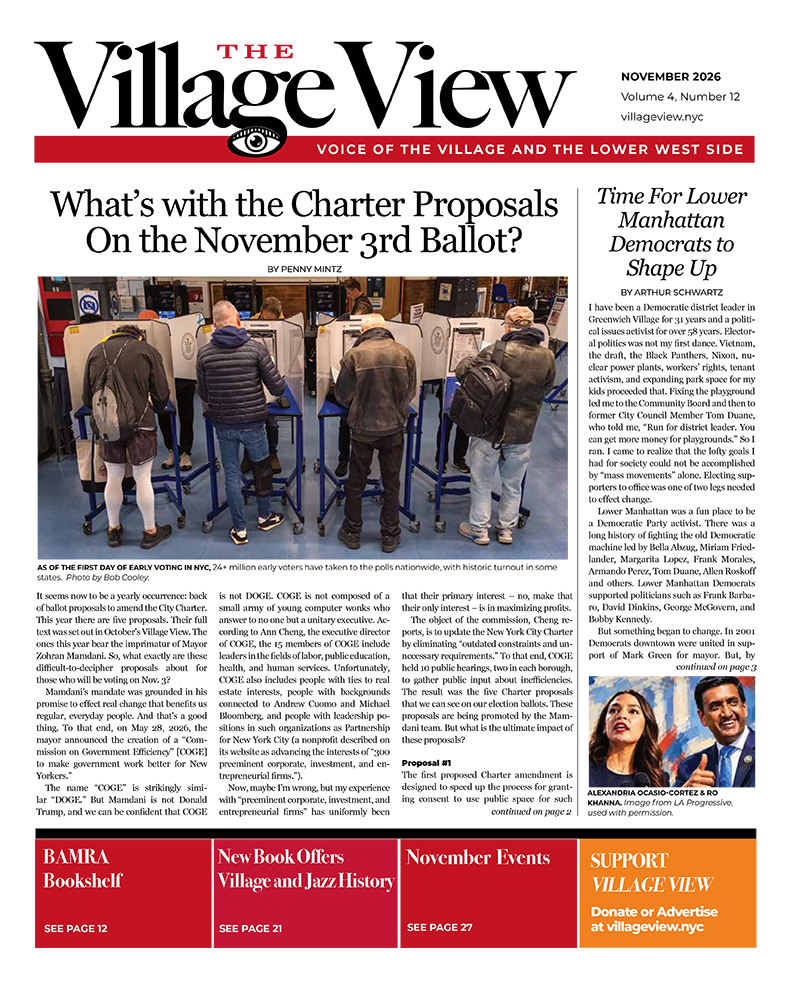
Gorgeous New Book Offers Treasure Trove of Village and Jazz History
By Phyllis Eckhaus

LAST OF THE JAZZ JOINTS book cover. Credit: Michael Larson
If the Village has played an outsize role in American — dare one say Western? — culture, it’s thanks largely to a legendary array of idiosyncratic promoters and performance venues.
Deborah Gordon’s terrific tribute to one such venue, The Last of the Jazz Joints: An Incomplete History of the Village Vanguard, shows what it takes to create a space hospitable to cutting-edge performers. Her book is clearly a labor of love — dad Max founded the Vanguard in 1934, her mom Lorraine took over the legendary Seventh Avenue South cellar joint when her dad died in 1989, and Deborah herself assumed the reins after Lorraine’s passing in 2018.
Yet Gordon’s gorgeous, lavishly color-illustrated, 350-page tome is so much more than a sentimental journey. With the same discernment, intelligence, passion, and panache displayed by her parents, she conveys how the Vanguard — which has so far hosted nearly 200 live jazz recordings — became known worldwide, an icon of iconoclastic artistry.
More than Jazz: From Poetry to Satire
In 22 mostly chronological chapters, Gordon traces the Vanguard’s history from a poets’ mecca to a renowned jazz joint.
There was tumult from the get-go. The place, briefly on Charles Street, began as a classic Village hangout where local writers — Max Bodenheim, Harry Kemp, and Joe Gould among them — performed their work. On opening night, club owner Max received a summons for offering entertainment without a cabaret license. The next day, he successfully defended himself at Jefferson Market Courthouse (now the Jefferson Market Library), by claiming, “Your Honor, that was no entertainment,” merely poets “declaiming to each other.”
Soon, the poets went on strike for more money. Max fed them meals as they picketed, and told a reporter he thought they were geniuses.
To this reader’s nerdy joy, Deborah Gordon reproduces the newspaper clipping and ─ lo and behold ─ the reporter was Ruth McKenney, then living at 14 Gay Street with her sister Eileen. McKenney, after she quit the New York Post, wrote the stories that became the book My Sister Eileen and the play and movie Wonderful Town.
Remember Wonderful Town, with music by Leonard Bernstein and lyrics by Betty Comden and Adolph Green? Comden and Green, along with soon-to-be-famous Judy Holliday, were the core of the singing satirical troupe The Revuers. Back in 1938, the young Revuers were untested when Max Gordon gave them their first gig at the Vanguard, with their pal Leonard Bernstein often at the piano. The troupe’s success launched their careers and blessed the Vanguard with cash as well as cachet. Max was able finally to buy a liquor license and install a bar.
Another Vanguard staple was comic “Professor” Irwin Corey, the double-talking, pretend academic who first took to its stage in 1942. Comic Wally Cox made his 1949 debut at the Vanguard, and was such a hit he gave up his day job as a West Fourth Street silversmith.

CALYPSO CARD from 1939. Photo courtesy of The Village Vanguard.
Max also sparked the 1940s “calypso boom,” first with the Calypso Recorders, who performed satirical material. Later, calypso-singing Harry Belafonte became a regular, becoming so popular he gave up his day job as the proprietor of a Grove Street hamburger stand.
With the encouragement of amateur folklorist Nicholas Ray (later the director of famed films, Rebel Without a Cause among them), the Vanguard apparently became the first night club to present folk musicians, starting with Josh White and Lead Belly in 1941. Max asked Woody Guthrie what he thought of that performance. Gordon reproduces the first page of Guthrie’s five-page typed, single-spaced response. It is a testament to her classy trust in her audience that she lets us discover Guthrie’s prescient praise without quoting it in the text. He declared the act could “make real night club history…[giving] the Negro people a real honest chance to bring their music and singing before the general public,” and spurring entertainment gatekeepers to open up “a whole new field for entertainers of all colors.”
Downtown and Uptown
Gordon includes a chapter on the Blue Angel, the upscale, uptown East 55th Street nightclub that Max launched with a partner in 1943 — and the contrast is revelatory, uptown chic versus downtown cheek. Television scouts haunted the Blue Angel, and some acts — Peter, Paul and Mary and Carol Burnett, for example — promptly became so popular, Max was priced out.
But when comic Lenny Bruce bombed at the Blue Angel in 1960, he sent Max a three-page telegram: “I want the Village Vanguard — my kind of place where my kind of people will come to see me.” And he was right, soon packing the Vanguard for weeks.
A Smorgasbord of Jazz Treats
It’s jazz that ultimately made the Vanguard — and brought Deborah Gordon into existence. Lorraine’s relentless promotion of groundbreaking bebop pianist Thelonious Monk led her to hunt down and badger Max to give Monk his first gig in 1948. The two passionate artists’ advocates married in 1950.
The Vanguard ultimately became a full-time jazz club, and multiple chapters give aficionados plenty to pore over. The section on singers spotlights a stellar lineup of women vocalists, Abbey Lincoln, Mary Lou Williams, Anita O’Day, Dinah Washington, and Betty Carter included. Another chapter recounts the back stories of groundbreaking live albums by Sonny Rollins, Bill Evans, John Coltrane, Dexter Gordon, and Joe Henderson. Max’s longtime relationships with Miles Davis, Charlie Mingus, and Rahsaan Roland Kirk get full treatment. A 30-page discography includes full color album covers. A tribute to the cellar’s unique acoustics ties the club’s sound directly to Village topography — the triangular space created in 1913 when subway expansion leveled lower Seventh Avenue.

CHARLES MINGUS at the Vanguard. Photo credit: Hozumi Nakadaira.
In these days of crowdsourcing and algorithms, it’s easy to forget the special thrill of art that is not mainstream mass market. Like the Vanguard itself, Gordon’s self-published book is that kind of thrill, available only to those who know enough to seek it out. A fabulous gift for fans of music and cultural history, it is available at the Village Vanguard and on its website.