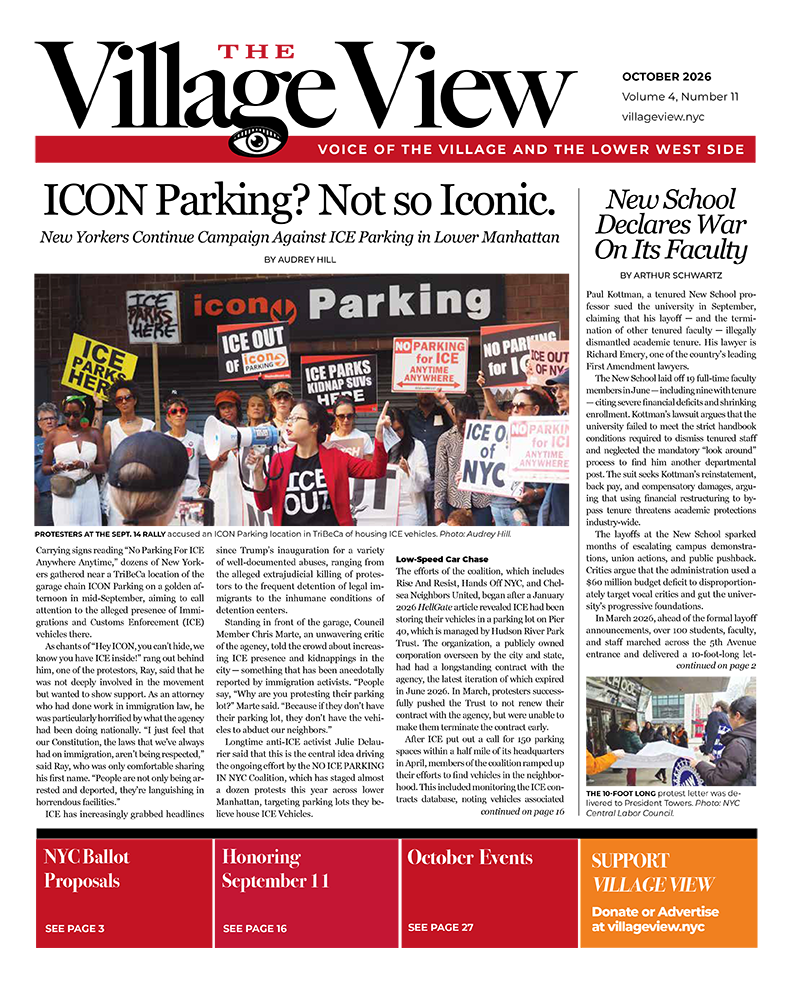
Jefferson Market: From Prison Walls to Public Garden
By Corinne Neary

VIEW FROM 1 CHRISTOPHER STREET after the Women’s House of Detention demolition. Photo by Terence McCarten.
We are thrilled to announce our new exhibit, Before We Had a Garden: An Archival History of the Women’s House of Detention Site, and What Came Before and After. This exhibit, up now through mid-December in our Little Underground Gallery, is the first of what we hope will be many sourced entirely from our library archive, and put together by us, your librarians.
About the exhibit: The Jefferson Market Garden celebrated its 50th anniversary this fall. Longtime residents of Greenwich Village will remember that before we had a garden, on its site stood the Women’s House of Detention, which was opened in 1931, and demolished in 1973, having stood vacant for two years.
However, this was not the first jail on this land. A police court and jail stood there, an annex to the original Jefferson Market structure, beginning in 1849. When the Jefferson Market Courthouse, which is now Jefferson Market Library, was erected in 1877 a red brick structure that held a jail was attached, standing behind this building, where the garden is now. The prison was five stories high and had 96 cells — 64 in four tiers for men and 32 in two tiers for women. That structure was demolished in 1929, to make way for the then state-of-the-art Women’s House of Detention.
In this exhibit, with original materials sourced entirely from our library archive, the complicated history of this site is further explored, as well as the role of the community in shaping its future. The garden, originally designed by Pamela Berdan, came to be despite numerous other plans for the site, including a library extension, a New School annex and a neighborhood arts center. The story is told here, through original correspondence, building plans, library design sketches and never before seen personal photographs.
Exhibit highlights include extensive capital planning documents showing the projected cost in 1973 for the library annex building, as well as the proposed needs of the library at the time. Jefferson Market’s original library manager, Phillip Gerrard, wrote a proposal which includes lounges for smoking and typing, as well as a theater with raised seating for an audience of 200. There is also a booklet containing blueprints for another proposed project: a neighborhood arts center designed by Giorgio Cavaglieri, the architect responsible for our library conversion.
Original garden-related items on display include Pamela Berdan’s sketches for the space, as well as itemized pricing lists for the original garden planting. On the more personal side, Berdan’s snapshots of her gardens and her beloved cat, as well as friends, are included. I would be remiss if I neglected to mention some of the changes made to the garden since 1999, when horticulturalist Susan Sipos took over the plantings and design. Where there was once a gravel path, we now have a brick walkway to ensure ease of access. The garden did not originally have an open lawn as a centerpiece, but an area full of shrubs and ivy, which was not pleasing to the eye. We also have Sipos to thank for the rose garden, and the larger pond, now home to a family of frogs.
When you visit the exhibit in our basement gallery, please note that it begins in the curved brick walled vestibule at the foot of the spiral staircase. Here we have installed a timeline for those interested in how the space has changed over the years since the market was first built in 1849.