
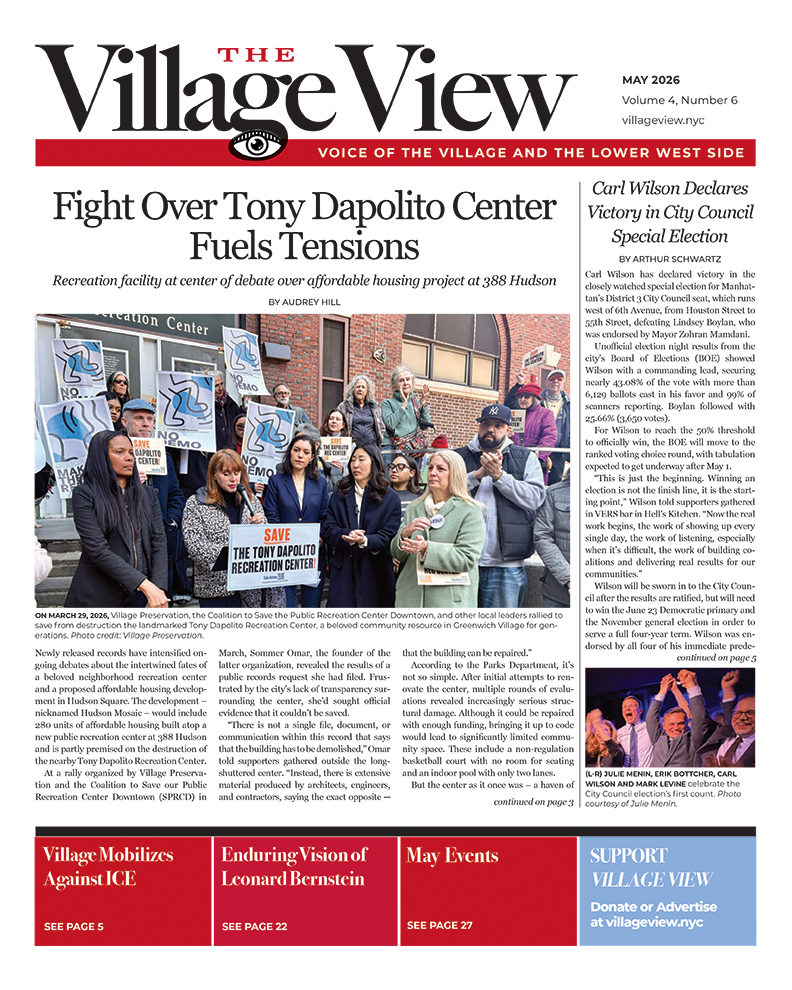
Fight Over Tony Dapolito Center Fuels Tensions
Recreation facility at center of debate over affordable housing project at 388 Hudson
By Audrey Hill

ON MARCH 29, 2026, Village Preservation, the Coalition to Save the Public Recreation Center Downtown, and other local leaders rallied to save from destruction the landmarked Tony Dapolito Recreation Center, a beloved community resource in Greenwich Village for generations. Photo credit: Village Preservation.
Newly released records have intensified ongoing debates about the intertwined fates of a beloved neighborhood recreation center and a proposed affordable housing development in Hudson Square. The development – nicknamed Hudson Mosaic – would include 280 units of affordable housing built atop a new public recreation center at 388 Hudson and is partly premised on the destruction of the nearby Tony Dapolito Recreation Center.
At a rally organized by Village Preservation and the Coalition to Save our Public Recreation Center Downtown (SPRCD) in March, Sommer Omar, the founder of the latter organization, revealed the results of a public records request she had filed. Frustrated by the city’s lack of transparency surrounding the center, she’d sought official evidence that it couldn’t be saved.
“There is not a single file, document, or communication within this record that says that the building has to be demolished,” Omar told supporters gathered outside the long-shuttered center. “Instead, there is extensive material produced by architects, engineers, and contractors, saying the exact opposite ─ that the building can be repaired.”
According to the Parks Department, it’s not so simple. After initial attempts to renovate the center, multiple rounds of evaluations revealed increasingly serious structural damage. Although it could be repaired with enough funding, bringing it up to code would lead to significantly limited community space. These include a non-regulation basketball court with no room for seating and an indoor pool with only two lanes.
But the center as it once was – a haven of community, a working class oasis, and a beacon of summertime in the city – is not so easily wrested from the hearts of its supporters.
Michelle Ray Cruz grew up going to the recreation center and now organizes reunions of alumni from the center’s programs. “It’s not just a building, it’s a community that people travel to come back to,” she said at the rally. Directing her inquiry at the decision makers involved in the project, she asked, “Are you going to invest in this community and its potential, or erase it?”
While the Hudson Mosaic complex would likely seal the fate of the beloved center, supporters of the project argue it will make room for a superior, if less sentimental, array of resources – including a regulation-sized pool and basketball courts. The project is part of a larger plan to revamp the area released by the Adams administration in August 2025 that includes public park spaces and art installations along Clarkson Street and preserves an iconic mural by Keith Haring.
Village Preservation has long fought for the preservation of the Tony Dapolito center and taken issue with various iterations of affordable developments at 388 Hudson. Andrew Berman, the group’s executive director, said that while they support affordable housing, they are wary of lofty promises made by developers and the city and that their input has largely been ignored.
In Berman’s view, Hudson Mosaic will not be “contextual” with the neighborhood and the new recreation center is too large because it’s designed to entirely replace the Tony Dapolito center. “We wanted it to be fixed up and reopened,” he said. “If they do that, a lot of the space that they’re planning for the rec center won’t be needed in the new building.”
Berman also cast doubt on one of the developers for the project, Camber Property Group. Rick Gropper, Camber’s founding principal, Berman said, was listed on the Public Advocate’s list of “worst landlords.”
“You want a developer with a good track record who doesn’t have a thousand violations and isn’t infamous for evicting his low income tenants,” Berman said.
In an email, Camber spokesperson John DeSio said that the Department of Housing Preservation and Development (HPD) often turns to Camber to take over buildings in distress, which temporarily inflates the number of violations that properties in their portfolio have. Once in charge of a building, they work quickly to decrease the number of violations. HPD confirmed both of these characterizations.
“Affordable housing opponents are grasping at straws in an effort to block a 100% affordable project,” an HPD spokesperson said. “What they are really attacking here is the creation of new homes for lower incomes.”
The project would include a mix of individual and family units and house people with incomes ranging from to 40 to 100% AMI (area median income). Fifteen percent of the units would specifically be set aside for formerly unhoused people and a floor of the building would be dedicated to onsite support services for residents.
Tobi Bergman, a neighborhood resident and Community Board 2 veteran, has lived in the area since he was five, when his family moved from uptown in 1952. He said the diverse, bohemian, and culturally rich Village of his boyhood is gone.
According to a neighborhood profile on Niche, more than two thirds of Greenwich Village is white and the average income is $180,000. Bergman argued that the Hudson Mosaic complex is a rare opportunity to bring 100% affordable housing to an area that sorely needs it. “Our neighborhood needs people who need affordable housing,” he said. “We are becoming more and more of a monolithic wealthy neighborhood – we used to be a mix of wealthy people, artists, middle class people, immigrants, everyone.”
Bergman was chair of Community Board 2 in 2015, when the body first offered 388 Hudson as a spotential site for affordable housing. He said that people say they want affordable housing, but their support is often premised on restrictive conditions – small buildings, the lowest AMI, and 100% affordable housing guaranteed forever – that would make building that housing almost impossible.
Still, the Tony Dapolito center remains a sticking point: at the end of the day, many simply aren’t ready to let go of a place that has meant so much for so long. For now though, to the delight of some and ire of others, it seems that the city will be moving ahead with the Hudson Mosaic project.



Trackbacks/Pingbacks